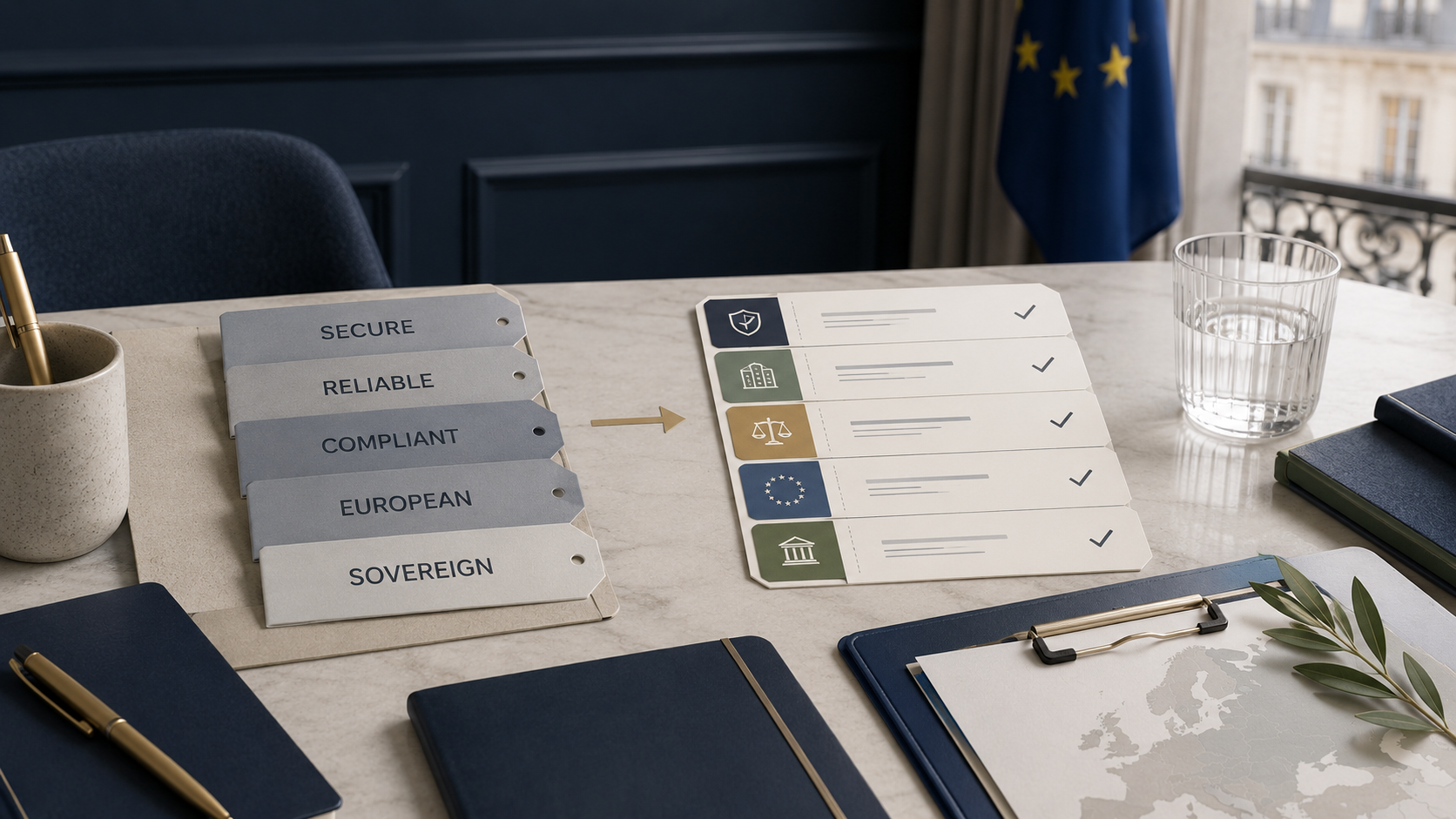
With increasing frequency, consumers, partners and procurement professionals expect technology vendors to convey more than just product characteristics and functionality. Therefore, as a result of this expectation, the language of "trust" has emerged as a major component of technology vendor marketing. Vendors today describe themselves as secure, resilient, compliant, transparent, European and sovereign. While many of these terms represent real capabilities and significant investments by the vendors, they are frequently applied too broadly to be of practical utility.
Thus, the main issue is not that the claims are false. Rather, the issue is that the same word(s) can have vastly different meanings.
There are multiple meanings to the same description
Take, for instance, the description "European technology provider." To one vendor, this could mean that the vendor's parent company is located in Europe. To another vendor, it could mean that the majority of engineers who develop products are located in Europe. To a third vendor, it could mean that the vendor operates under a European-based brand name, yet the vendor uses extensive amounts of non-European-based owned or controlled infrastructure. All three vendors may have valid reasons to identify themselves in this manner; however, all three would have made claims that were not equal.
Similarly, the problem exists with other popularly-used descriptions. "Secure" may refer to either technical controls (e.g., encryption), internal policies or procedures (e.g., incident response plans), compliance with a specific industry-standard (e.g., HIPAA/HITECH) or other factors. "Resilient" may refer to a variety of things including service availability, continued delivery of goods or services from suppliers during times of disaster or crisis (i.e., supply chain continuity), financial stability (i.e., cash reserves sufficient to weather a financial storm), etc. Without additional explanation, each of these terms provides minimal guidance to those expected to act upon them.
Vague language disadvantages some companies
In addition to creating ambiguity for purchasers/clients; vague trust-related claims also may unfairly disadvantage vendors that have invested considerable resources to establish European-based control, operations, security practices or infrastructure. One vendor may have substantially reduced dependencies, maintained strategic control over key aspects of its operation and created economic value within Europe. However, if the vendor describes these strengths through the same general terms used by all vendors; then their specific strengths are easily lost in the process.
Therefore, vendors possessing strong foundations face a communications dilemma: they must continually explain the specifics behind their claims while generic statements regarding trust appear similarly legitimate at least initially. This is particularly true for smaller and newer European technology vendors. In contrast to larger established global technology vendors; new European vendors typically lack sufficient branding reputation to immediately engender confidence. Therefore, their claims must possess more detail not merely more enthusiasm.
Additional clarity does not equate to increased complexity
The solution is not to substitute each and every claim with lengthy technical or legal explanations. Most audiences do not require access to all of an organization's internal policies, diagrams of all its infrastructure or records of all of its corporate activities prior to engaging in a commercial discussion. Instead, what most audiences desire is clarification regarding the scope and validity of the claim.
Therefore, a more useful trust-related statement should assist in answering questions such as:
• Exactly what is being asserted?
• Which element of the vendor/company/product/service is covered by the assertion?
• On what basis was the assertion made?
• Was the assertion based upon the vendor’s own declaration; independent assessment; some other method of validation?
• Is the information still accurate?
• Are there any relevant limitations or dependencies associated with the assertion?
By providing answers to these types of questions; a claim can be clarified without limiting accessibility.
For example, stating a vendor is "European," represents a generalized perception. Stating that an assertion related to "Europeanness" pertains exclusively to "ownership," "operational control," "product development," or "infrastructure"; enables stakeholders to comprehend and evaluate an assertion.
Clarity transforms a positioning statement into useful market intelligence.
Trust depends on scope.
Another critical aspect of a reliable claim is its relevance.
An organization might satisfy a certain requirement for one product; however, not for all of its services. An organization's data might be stored in Europe; although operational or infrastructural dependencies continue globally. A vendor might maintain its headquarters in Europe; whereas ultimate ownership resides somewhere else.
None of these differences necessarily diminishes the trustworthiness of an organization. Organizations operating in modern technologies are highly complex systems and completely eliminating dependence upon external entities is virtually impossible.
The problem occurs when a broad assertion suggests more than existentially-supported facts.
Defining boundaries clearly enables organizations to accurately report their strengths while recognizing where assertions begin and end. By doing so, organizations protect their credibility and make it easier for customers and partners to ascertain whether an organization possesses relevant strengths corresponding to their respective needs.
Consistent verification supports communication.
When trust-related claims are verifiable on a consistent basis; they are most useful. Self-asserted claims will always comprise some portion of organizational communication; however, they assign responsibility for verifying truthfulness solely to the readership. Consequently, potential customers must individually formulate their own inquiry regarding evidence; interpret that evidence; and conclude whether the assertion adequately reflects existing reality.
Both parties experience redundancy as a result. Both vendors and purchasing/procurement/legal/security/risk departments must repeatedly address similar inquiries while evaluating similar forms of documentation. Additionally, different organizations may employ differing definitions of identical concepts; thus rendering identical vendors apparently satisfactory in one evaluation while unclear in others.
A more standardized approach toward validating reliability may alleviate this redundancy. Furthermore, a consistent methodology for supporting assertions can enable vendors to present their competitive advantages in ways that travel beyond individual sales conversations/questionnaires/tenders. Finally, establishing a common baseline for initiating due diligence will provide stakeholders with improved clarity prior to commencing detailed assessments.
Validation will never eliminate judgment. Validation will only render clearer the base upon which judgments are formed.
Clarifying trust-related language improves the overall quality of the market.
Enhanced precision in defining trust-related terminology improves the competitiveness among reputable vendors; facilitates comparable evaluations regarding pertinent strengths among various clients/vendors; and motivates vendors to transition beyond general positioning and define substantive backing for their assertions.
Ultimately, this can lead to a more disciplined vocabulary in describing trust/resiliency/sovereignty concepts that become increasingly germane to numerous commercial decision-making processes – i.e., procurement/partnerships/investment/risk management/long-term technology strategies.
Claims about trust start with claiming something; credibility starts with explaining what you mean by your claim.
TET believes European technology vendors should be able to describe their strengths in a manner that is specific/substantiated/uniform across markets. Our objective is to contribute toward an environment within European technology in which essential trust-related claims are conveyed clearly rather than merely repeated.